How SEO, Google Ads, and Instagram Work Together for Med Spas
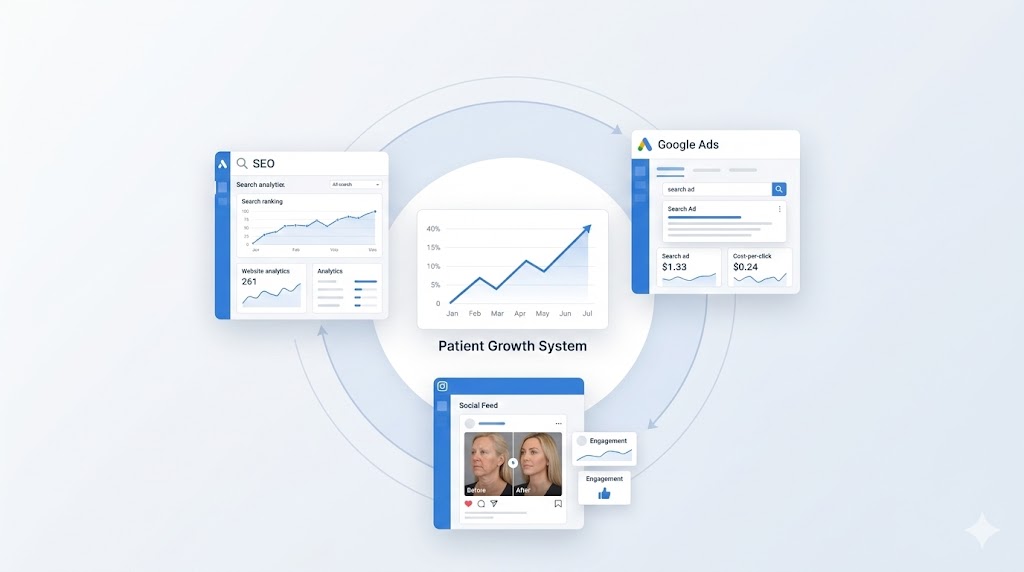
The Med Spa Growth Stack: How SEO, Google Ads, and Instagram Actually Work Together
Most med spa owners do not need more tactics. They need the channels they already use to work like one business instead of three separate ones.
That means Google Ads sending traffic to pages that can actually convert, Instagram sending people somewhere better than a generic homepage, and SEO work showing up on the treatment pages that matter when someone is ready to book.
We looked at 1,836 med spa websites across 49 U.S. cities. The same pattern showed up over and over.
The fastest-growing med spas are usually the ones that connect SEO, Google Ads, and Instagram instead of treating them like separate line items.
Here's how the growth stack actually works—and why treating these channels separately is your most expensive mistake.
The Three Engines, Defined
SEO: The Compounding Equity Engine
Think of SEO as buying real estate. It costs money upfront and monthly (content, technical optimization, links), but every dollar builds equity in your website's authority. After 6–12 months, your website ranks for hundreds of keywords, driving free traffic daily.
Unlike ads, traffic doesn't stop when you stop paying. A blog post about "How Long Does Botox Last?" might pull 10 visits in Month 1, but 100 visits in Month 6, 200 in Month 12, and 300+ in Month 24. You write it once; it drives patients for years.
The SEO Gap in Your Market
- 67.8% of med spas (1,244) score 4–5 on SEO maturity
- 32.2% (592 businesses) leave organic traffic on the table with weak SEO
- 54.7% don't include their city in their title tag—like owning a storefront and forgetting to put your location on the sign
The compounding nature of SEO is irreplaceable. No other channel does this.
Google Ads: The Intent Capture Engine
Google Ads is the cash register. Someone types "Botox Austin TX"—they want Botox, in Austin, right now. They're not browsing. They're ready to book. You've got seconds to convert them.
The advantage is speed. You can turn on ads today and have patients calling tomorrow. The trade-off: you pay for every click. When you stop paying, traffic stops. It's a faucet, not a well.
Cost Per Click by Market (Med Spa Average)
- Austin, TX (SEO maturity 4.29): $12–28 CPC
- Boston, MA (maturity 4.23): $12–28 CPC
- Houston, TX (maturity 3.8): $10–22 CPC
- Scottsdale, AZ (maturity 3.6): $10–20 CPC
- Arlington, TX / Minneapolis, MN (maturity 2.96): $8–15 CPC
Instagram: The Desire and Brand Engine
Instagram does something neither SEO nor Google Ads can: it creates demand where none existed. Nobody wakes up typing "should I get lip filler" into Google. They see a before-and-after Reel. They watch an injection process in real time. They see results on real people. Then they want it.
Instagram is your brand-building machine. Every post, Story, and Reel builds familiarity and trust with your local audience. When someone later searches your name on Google, they already feel like they know you. That shortcut to trust reduces friction across every other channel.
66% of med spa decision-makers are owner-operators. They respond to Instagram because it shows them real people behind the business. They're not buying from a faceless corporation—they're choosing a provider they already know.
How the Channels Feed Each Other: The Flywheel
Here's where it gets interesting—and where most med spas miss the entire point of integrated marketing.
SEO Makes Google Ads Cheaper
Google Ads uses a Quality Score (1–10) to determine your cost per click. It measures: expected CTR, ad relevance, and landing page experience. That last one is directly determined by your SEO work.
When you optimize treatment pages for SEO (fast load, relevant content, proper headers, mobile-friendly, city + service in title tag), those same pages score higher as Google Ads landing pages.
The Math:
Quality Score increase from 5 → 7 = 28.6% CPC reduction
On a $2,000/month budget: ~$570 saved monthly = $6,840 annually
One investment. Two returns.
Google Ads Build Data for SEO Decisions
Here's a tactic almost nobody talks about: use your Google Ads keyword data to inform SEO content strategy. Google Ads gives you immediate, real-world data on which keywords convert into booked appointments—not just clicks, but revenue.
If "laser hair removal [city]" converts at 8% from ads and "hydrafacial [city]" converts at 3%, you know exactly which treatment page deserves more SEO investment.
Without ads, you'd spend 6–12 months optimizing before knowing which keywords drive revenue. Google Ads gives you that answer in 4–6 weeks. Then double down on SEO for proven winners.
Instagram Drives Warm Retargeting Audiences
Every Instagram visitor gets pixeled. That visitor now lives in your retargeting audiences on both Instagram and Google.
Cost comparison:
- Cold Google Ads click: $10–25
- Retargeting click: $2–5
If Instagram drove 500 visitors this month and 80% didn't book, that's 400 warm leads you can retarget at a fraction of cold acquisition cost. Your effective CPA drops across the entire system.
Brand Recognition Lifts Organic CTR
When someone has seen your med spa on Instagram—your before-and-afters, your team, your aesthetic—and then sees your listing in Google search results, they're far more likely to click.
Brand-familiar searchers click organic listings at 2–3x the rate of unfamiliar brands.
Higher organic CTR signals Google that your result is relevant. Google responds by ranking you higher. Higher rankings mean more clicks, more data, more patients, more reviews, more authority. The flywheel accelerates with every revolution.
What the Data Shows About Multi-Channel Med Spas
In our study of 1,836 med spa websites, the top tier tells a consistent story:
SEO Maturity Level 5: 21.6% (396 businesses)
These aren't just technically sound websites. They're sophisticated, multi-channel marketing operations.
Using UTM Tracking on GBP: 19.1%
This indicates marketing sophistication. They're measuring and optimizing channel performance. They know which channels drive patients.
CTA-Heavy Conversion Design: 6.7%
Their sites are built to convert, not just inform. This suggests active optimization and paid ad activity.
Key insight: These three signals—strong SEO, tracking sophistication, and conversion-focused design—almost always appear together. The med spas that nail one tend to nail all three. It's not coincidence. It's the result of thinking in systems instead of checking marketing boxes.
Meanwhile, the bottom 25.9% (476 businesses scoring 1–2 on SEO maturity) are running disconnected, incomplete marketing. They're leaking patients at every funnel stage.
The Growth Stack Framework: How to Build It
Layer 1: SEO Foundation (Months 1–2)
- Title tags: [Service] in [City, State] | [Brand]. 50–60 characters. This can increase organic traffic 15–30% alone
- Meta descriptions: Compelling 140–155 character copy with value prop and CTA
- Treatment pages: Create dedicated pages (not a "services" list) with booking widgets, before-and-afters, FAQs
- Google Business Profile: Complete every field, add 20+ photos, start weekly Google Posts
- Conversion tracking: GA4, Search Console, comprehensive event tracking
Layer 2: Google Ads (Month 1, Simultaneous)
- Launch campaigns targeting your top 3–5 revenue treatments
- Send all ads to treatment-specific pages, never the homepage
- Track booked appointments, not just clicks or leads
- Use keyword data from weeks 4–6 to inform SEO priorities
Layer 3: Instagram (Months 1–2)
- Post 4x per week: before-and-afters, educational content, behind-the-scenes, testimonials
- Install Meta pixel on every page. Start building retargeting audiences Day 1
- Launch retargeting by week 6 to non-bookers. Budget: $150–200/month
- Drive traffic to treatment pages using link-in-bio tool, never homepage
Layer 4: Connect the System (Months 2–3)
- Use Google Ads data to prioritize SEO content for high-converting treatments
- Cross-channel retargeting: Google visitors on Instagram; Instagram visitors on Google
- Monitor blended CPA across all channels, not just individual metrics
- As organic grows (months 4+), reallocate ad budget to scale winners
The Flywheel Effect: Month 6 and Beyond
By month 6, the flywheel is spinning. Your SEO drives organic traffic that costs nothing per click. Your Google Ads run on optimized pages with Quality Scores of 7+, so you pay less per click than competitors with weaker websites. Your Instagram has a real, engaged local audience fueling warm traffic and retargeting on both platforms.
Every month, each channel makes the others slightly cheaper and slightly more effective. That incremental improvement compounds.
By month 12, your blended CPA is 30–50% lower than month 1, even as your total patient volume has doubled or tripled.
The med spas in the top 21.6% of our study (maturity level 5) didn't get there by accident. They built the stack. They connected the dots. They treated marketing as one system, not three line items on a spreadsheet.
The System vs. The Pieces
The question isn't whether you can afford to build the growth stack. It's whether you can afford not to—while the competitor across town already has.
Ready to Build Your Growth Stack?
We'll audit your current marketing setup and show you exactly where you're leaving money on the table—and how to build the system that puts it back.
Book Your Free Growth AuditLearn more about how we build this for med spas: The Med Spa Growth Stack →