What We Check in a Med Spa Online Presence Audit
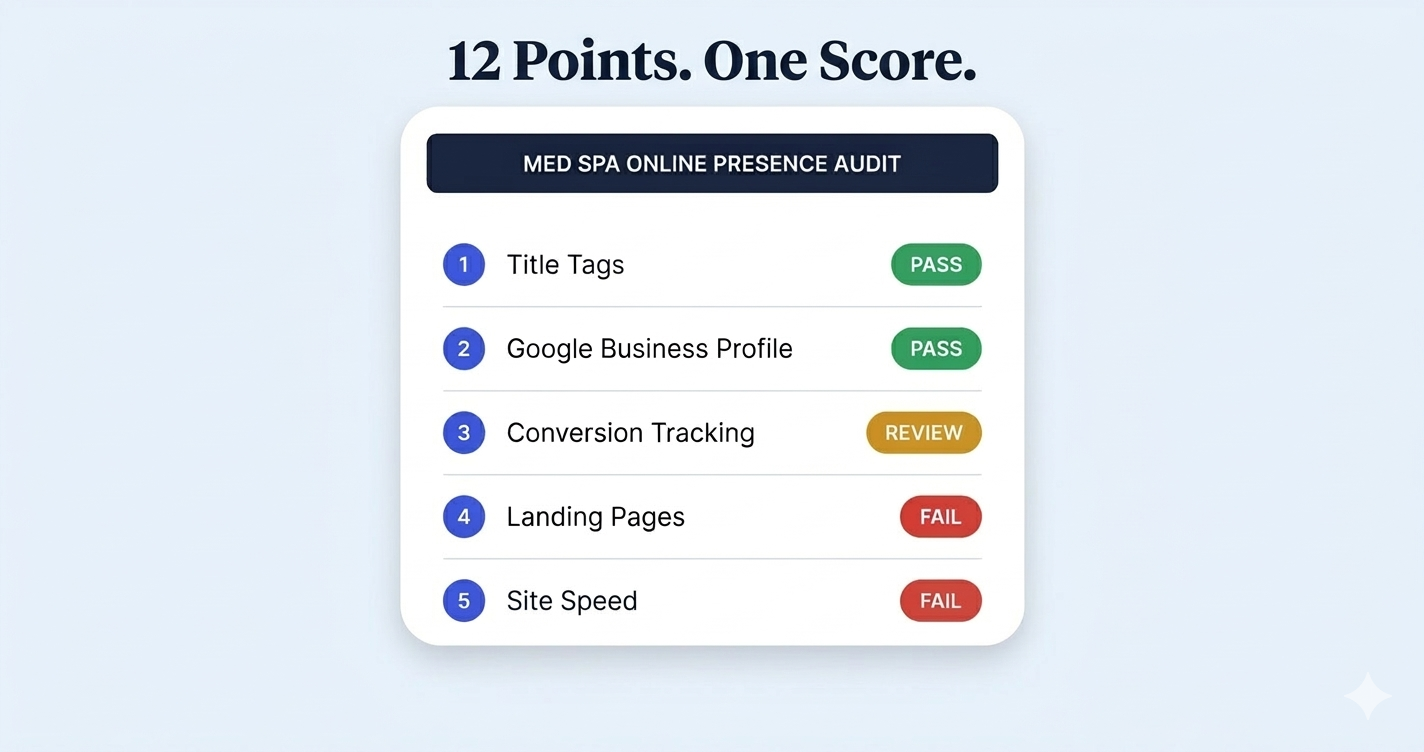
When a med spa owner says the marketing feels off, we do not start with opinions. We check the same 12 things every time, because the weak spots tend to show up in the same places. This post walks through that checklist so you can use it on your own practice.
Point 1: Title Tag Optimization
What we check: Is your title tag 50-60 characters with primary keywords and your city name?
Your title tag is the clickable headline in Google and the single fastest SEO fix most med spas ignore. Many leave out their city, making it harder to compete for the local searches that actually matter. Others use titles that are too short, too vague, or too long to communicate relevance clearly.
Passing grade: A title tag between 50-60 characters that includes your primary service keyword, your city and state, and your brand name.
Point 2: Meta Description Quality
What we check: Is your meta description compelling, keyword-rich, and action-oriented?
The meta description is often your first sales pitch in search. It does not directly determine rankings, but it heavily influences whether a searcher clicks your result or someone else's. When it is missing, Google often fills the gap with weak copy pulled from random parts of your site.
Passing grade: A meta description between 150-160 characters that explains your services, mentions your location, and includes a clear call to action.
Point 3: Site Crawlability
What we check: Can Google actually read and index your website?
This is the technical foundation beneath everything else. If Google cannot crawl your pages properly, your website stays invisible regardless of how much effort goes into content or paid traffic. We regularly find rendering problems, indexing blocks left over from development, and site structures that search engines struggle to interpret.
Passing grade: All major pages are indexed and discoverable in Google, especially your homepage and key treatment pages.
Point 4: Google Business Profile
What we check: Are you using all GBP features, tracking performance, and posting regularly?
Your Google Business Profile is often the first thing a patient sees. Common gaps include incomplete service coverage, stale photos, no posting cadence, and missing tracking on the website link, which means the practice cannot tell how much local visibility is converting into real demand.
Passing grade: Complete service list, fresh photos, weekly posts, tracked links, strong categories, and useful Q&A coverage.
Point 5: Review Velocity and Management
What we check: How many reviews are you getting per month, and how are you responding?
Reviews affect both rankings and trust. The strongest profiles are not just highly rated, they are consistently active. We often see med spas with decent total counts but weak recency, which makes the business feel less active and less trusted.
Passing grade: A steady flow of new reviews, a strong average rating, and responses to all reviews within 48 hours.
Point 6: Conversion Tracking
What we check: Is GA4 installed with conversion events for form submissions, calls, and bookings?
If you cannot measure conversions, you cannot optimize anything. We often see site owners who know how many people visited the site but cannot say how many actually became booked appointments. That keeps marketing decisions stuck in guesswork.
Passing grade: Analytics configured for forms, phone clicks, and booking completions, plus paid tracking tied to real appointment outcomes.
Point 7: Landing Page Quality
What we check: Do you have dedicated pages for each major treatment with specific, optimized content?
A strong treatment page should support organic search, paid traffic, and conversion at the same time. Too many med spas still send traffic to generic services pages instead of focused treatment pages with clear context, proof, FAQs, and booking prompts.
Passing grade: Dedicated pages for your top treatments with unique content, strong visuals, FAQs, and a clear CTA above the fold.
Point 8: Instagram Presence
What we check: Posting frequency, content quality, engagement rate, and conversion elements.
Instagram is where visual trust gets built before booking intent fully forms. The pattern we see most often is inconsistency: an account that once posted often but now drifts with weak frequency and no clear path from profile visit to booking page.
Passing grade: Consistent weekly posting, active stories, balanced content themes, and a clear booking path from the profile.
Point 9: Google Ads Structure
What we check: Campaign structure, keyword targeting, Quality Scores, and landing page alignment.
Well-structured Google Ads accounts separate treatments by intent and send traffic to matching landing pages. Weak accounts combine services too broadly, target loosely, and drive traffic to the homepage, which raises costs and lowers booking quality.
Passing grade: Separate campaigns or ad groups by service, relevant landing pages, healthy Quality Scores, and tracking tied to booked appointments.
Case Study: Midtown Med Spa Funnel Fix
A growing clinic in a competitive market had steady ad spend and decent traffic, but weak booking consistency. Their ads were sending multiple treatment keywords to one generic services page, and follow-up tracking was incomplete.
After restructuring campaigns by treatment intent, building focused landing pages, and tightening conversion tracking, their booking rate improved within one month and cost per booked appointment dropped noticeably. The biggest lift came from message match between keyword, ad copy, and landing page content.
- Stronger lead quality from treatment-specific page routing
- Lower wasted spend by removing broad, low-intent traffic
- Clearer weekly optimization decisions from complete conversion tracking
Point 10: Site Speed
What we check: Mobile page load time and overall performance.
Most med spa traffic is mobile, so speed issues damage rankings and conversions simultaneously. Slow pages usually come from oversized media, script-heavy templates, and too many third-party tools loading at once.
Passing grade: Fast mobile load times and stable page rendering on common devices and networks.
Point 11: Schema Markup
What we check: Is local business and service structured data implemented?
Schema helps Google understand your business, your services, and your location with more precision. Many med spa websites still leave this entirely blank, which forces search engines to infer details instead of being told directly.
Passing grade: Accurate local business schema plus service-level markup where appropriate.
Point 12: Backlinks & Citations
What we check: Domain authority, inbound links, and consistency of local directory listings.
Authority still matters. For local search, citation consistency matters just as much as link quality. We often find businesses with plenty of listings but mismatched contact details across directories, which creates trust problems for search engines.
Passing grade: Consistent business information across major directories and a clean backlink profile built on credible local and industry sources.
Scoring Your Med Spa: Where Do You Stand?
Add up how many points you pass. Most med spas sit in the middle: some parts of the system exist, but they do not work together. The strongest performers do not just market harder. They make sure search visibility, paid traffic, reviews, social proof, and tracking reinforce one another.
- 10-12 pass: Top-tier foundation. Focus on scale.
- 7-9 pass: Strong base with clear gaps to close.
- 4-6 pass: Average. Too much revenue is leaking.
- 1-3 pass: Critical growth blockers are still in place.
- 0 pass: Your website exists, but it is not acting like a growth asset.
Want us to run this diagnostic on your med spa? Book a free audit.