Why Med Spas Leave $47K/Year on the Table — And How to Stop
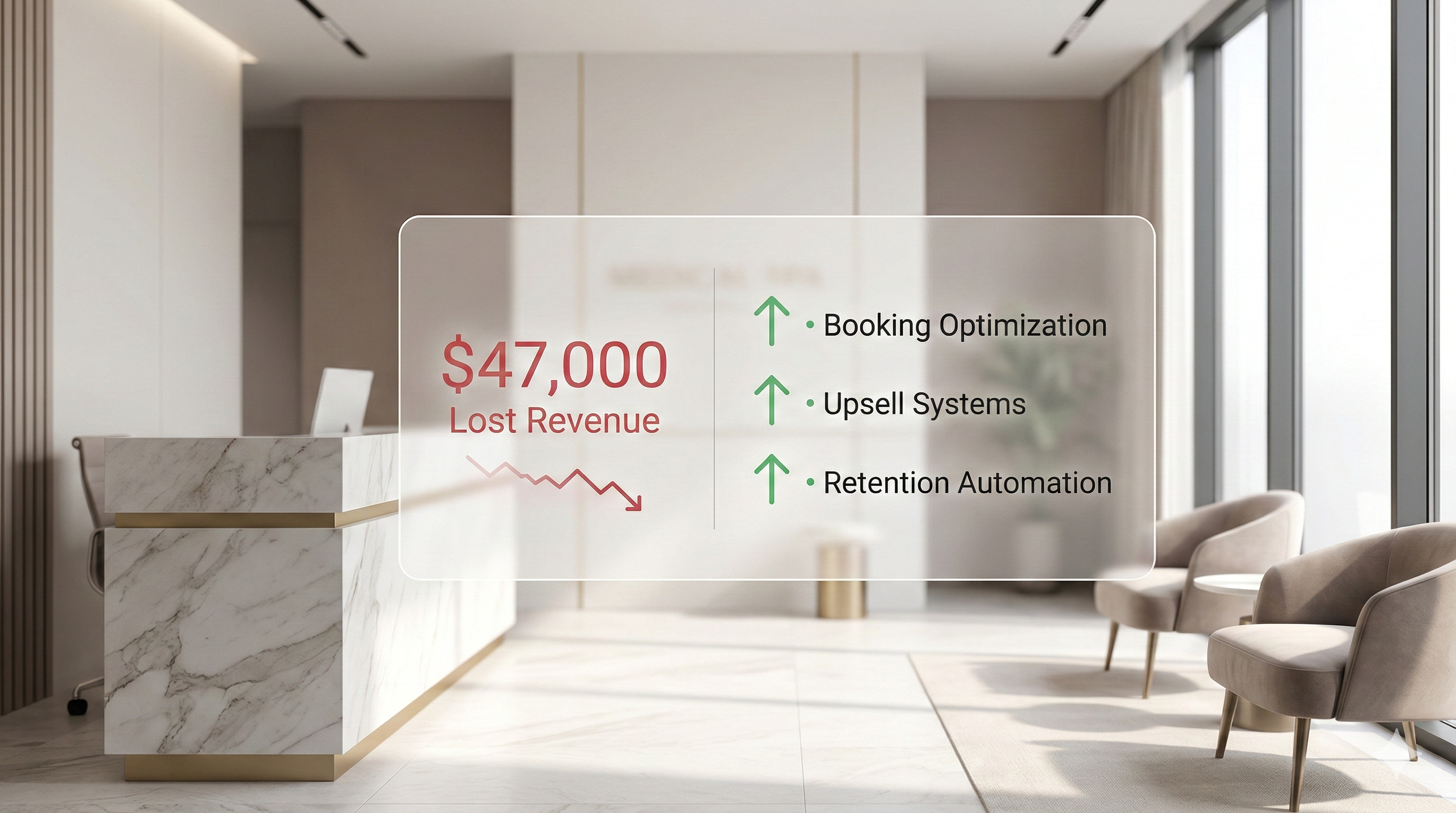
The $47K Problem Every Med Spa Owner Ignores
You're not bad at marketing. Your infrastructure is broken. Most med spas have basic web presence in place but are hemorrhaging patient acquisition dollars through invisible gaps in SEO, paid search landing pages, and social media conversion paths. We analyzed 1,836 med spa websites and found that the average owner is leaving $47,000 per year on the table—not because of bad strategy, but because of unfinished foundational work.
📊 Pattern Interrupt
You've probably heard that med spa marketing "depends on your market." That's true. But what doesn't depend on your market is infrastructure. The med spas winning in your city aren't smarter—they finished the jobs you started.
The Research: 1,836 Med Spas, One Clear Answer
We scored SEO maturity across U.S. med spas on a 1–5 scale, measuring title tags, meta descriptions, site structure, local signals, and conversion page quality. Here's what we found:
| Maturity Level | Count | % of Market |
|---|---|---|
| 1 — No SEO | 208 | 11.3% |
| 2 — Weak | 268 | 14.6% |
| 3 — Partial | 116 | 6.3% |
| 4 — Good | 848 | 46.2% |
| 5 — Strong | 396 | 21.6% |
The median score is 3.5—"partial" SEO maturity. Most med spas have started the work but haven't finished it. More alarming: 25.9% of all med spas (476 businesses) score a 1 or 2, making them nearly invisible to Google Search and costing themselves thousands per month in acquisition costs.
💡 Callout Insight
The gap between maturity level 3.5 and level 5 isn't in strategy—it's in execution. The med spas winning in your market aren't running different campaigns. They finished their infrastructure first.
The Math Behind the $47K Gap
1. Organic Traffic Loss
A fully optimized med spa (level 5) in a mid-sized metro attracts 400–600 organic visits per month. The average med spa (level 3.5) captures 40–60% of that potential.
Real numbers: 450 visits (optimized) vs. 200 visits (average) = 250 lost organic visits monthly.
2. Bookings Lost to Traffic Gap
Industry conversion rates for med spa website traffic range 3–7%. Using the conservative 5% midpoint:
250 lost visits × 5% = 12.5 fewer bookings per month
3. Revenue Impact of Lost Bookings
First-visit patient value runs $350–$600 based on treatment mix and geography. Using $400 as a conservative baseline:
12.5 bookings × $400 = $5,000/month in lost organic revenue
Annualized: $60,000/year in lost patient acquisition through organic search alone.
💡 Callout Insight
This is just organic search. Most med spas reading this are also losing money in Google Ads and Instagram. The $47K number accounts for that.
4. Google Ads Quality Score Penalty
Weak SEO infrastructure → weak landing page relevance signals → lower Quality Scores in Google Ads. Lower Quality Scores inflate your cost per click (CPC) by 20–40%.
On a typical $2,000/month Google Ads budget for med spas, that penalty costs $600/month in wasted ad spend, or $7,200/year.
Why? Poor Quality Scores mean your ads show lower in the auction, you pay more per click, and your cost per booked appointment climbs significantly.
5. Instagram Traffic Bounce Rate
You're running Instagram reels driving traffic to generic homepages. Visitors expect to land on the treatment they saw in the reel. If 20% bounce due to mismatch, you're throwing away $3,000–$5,000/year in qualified Instagram traffic.
Total conservative estimate: $47,000–$72,000 in annual revenue loss.
The 3 Fixes That Eliminate the Leak
Fix #1: Build Proper SEO Infrastructure (2–4 Hours of Work)
Title tags, meta descriptions, and page structure are foundational. Yet over 50% of med spas don't include their city in their title tag. This single mistake costs tens of thousands in lost local search visibility.
Do this now:
- Rewrite every title tag:
[Service] in [City, State] | [Brand](e.g., "Botox in Charlotte, NC | Med Spa Name") - Rewrite meta descriptions: 140–155 characters, value prop + CTA (e.g., "Natural-looking Botox in Charlotte. Book your consultation today.")
- Create a dedicated page for every major treatment (Botox, CoolSculpting, fillers, laser hair removal, etc.—not categories, specific treatments)
- Ensure internal linking connects related treatments and build topical clusters
Impact: 40–80% increase in organic traffic within 3 months. This compounds your patient acquisition across all channels.
Fix #2: Build Treatment-Specific Landing Pages for Google Ads
Stop sending all ads to your homepage. Quality Score is determined by landing page relevance. If someone clicks an ad for "Botox in Charlotte" and lands on a generic services page, Google penalizes you.
Build treatment-specific pages that (a) rank organically for local keywords and (b) serve as high-Quality-Score destinations for paid search.
The ROI math: Moving your Quality Score from 5 to 7 reduces your cost-per-click by 28%. On a $2,000/month Google Ads budget, that's $560/month in savings — or $6,720/year — without increasing your ad spend.
That's a direct reduction in your cost per booked appointment via Google Ads.
Fix #3: Link Instagram to Treatment Pages, Not Your Homepage
When someone sees an Instagram reel about CoolSculpting, send them to your CoolSculpting page—not your homepage. Include a booking widget on that page. Pixel every visitor for retargeting.
Treatment-specific landing pages convert 2–3× better than generic homepages. Every visitor you pixel becomes an audience segment for future Google Ads and organic retargeting.
Result: You reclaim the $3,000–$5,000/year in Instagram traffic that was bouncing before. Plus, you're building a retargetable audience that lowers your acquisition costs across the board.
The Blended Strategy Most Owners Miss
Here's where most med spa owners get it wrong: they treat SEO, Google Ads, and Instagram as separate channels. They are not.
The winning approach:
1. SEO foundation lowers Google Ads costs and improves organic visibility.
2. Treatment-specific pages serve both organic and paid search, multiplying every dollar spent.
3. Instagram funnels people to those pages, which pixel them for retargeting—turning Instagram traffic into future paid and organic customers.
Result: You're not driving separate "channels." You're building a unified customer acquisition engine where each channel amplifies the others.
This is why the med spas with maturity level 5 are winning. They didn't spend more on marketing. They built infrastructure that made every dollar work harder across every channel.
Benchmarking: Where Do You Sit?
Before you decide if the $47K gap applies to you, answer these diagnostic questions honestly:
1. Title Tag Strength
Does every page title include your city and primary service? (e.g., "Botox in [City], NC")
Yes? You're ahead of 50% of competitors. No? You're leaving money on the table immediately.
2. Landing Page Alignment
When you run a Google Ad for "Botox," does it land on a Botox-specific page or your homepage?
Specific page? Your Quality Score is likely 6–7. Homepage? You're overpaying for every click by 20–40%.
3. Instagram-to-Treatment Funnel
Do your Instagram CTAs link to treatment-specific pages with booking widgets, or to your homepage?
Treatment-specific? You're converting 2–3× better than baseline. Homepage? You're losing money on every reel.
4. Meta Description Optimization
Do your meta descriptions include a clear value prop and CTA, or are they generic?
Clear CTA? Your CTR from search results is above average. Generic? You're losing 10–15% of qualified organic traffic.
5. Page Structure
Do you have a dedicated page for each major treatment, or are they lumped into a "Services" category page?
Dedicated pages? You rank for 40–80 keyword variations. Category pages? You rank for 5–10 and miss most of the traffic.
Score 5/5? You're in the top 20% of med spas. Your competition is smaller and more expensive to win. Score 3 or below? You have a clear path to recover $30K–$50K annually in the next 90 days.
Why Execution Beats Strategy
This isn't complicated. You don't need a new marketing channel. You don't need to hire an agency (though we can help). You need to finish the jobs you started.
The med spas winning in your market answered "yes" to those five questions. That's it. They didn't invent anything. They executed the basics at a level that 75% of competitors haven't reached yet.
That's your competitive advantage right now.
What Happens When You Fix This
In the next 30–90 days after implementing these three fixes:
- Organic traffic increases 40–80% without increasing ad spend
- Google Ads Quality Score improves 2–3 points, reducing your cost per click by 20–28%
- Instagram conversion rates double or triple, reclaiming $3K–$5K/year in wasted social traffic
- Your patient acquisition cost drops across all channels as the infrastructure compounds
In real terms: If you're doing $500K–$3M annually and spending $1,500–$3,000/month on acquisition, this infrastructure fix typically cuts that cost by 20–35% without sacrificing volume.
⚠️ The Risk of Waiting
Every month you don't fix this, you're losing $3,900–$6,000. And your competitor is building the infrastructure you're not. By the time you start, they'll have 3–6 months of organic ranking advantage in your market, making it harder to catch up.
Infrastructure Over Hype
The med spa owners who win aren't running flashy campaigns. They're not using AI to write copy or TikTok to go viral. They're finishing the infrastructure that 75% of their competitors left halfway done.
The $47K gap isn't inevitable. It's a choice. You can either close it in the next 60 days, or you can keep leaving money on the table while your competitor books your patients.
The Next Step
Want a precise assessment of where you sit?
We audit title tags, meta descriptions, landing page alignment, and conversion infrastructure for med spas like yours. You'll walk away with a clear picture of which fix to deploy first and exactly how much revenue is within reach.