The Med Spa Marketing Math: How $3,000/Month Turns Into $180K in Annual Revenue
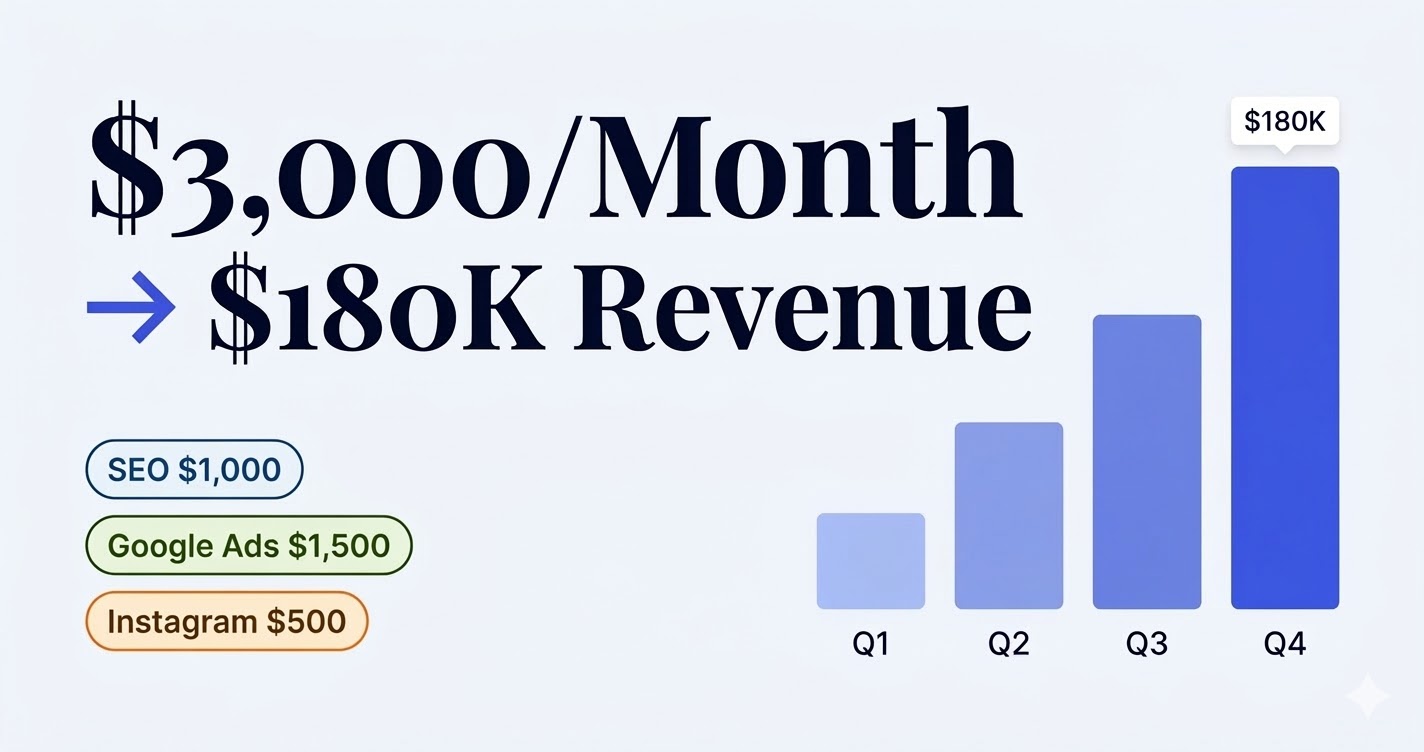
Med spa owners love data when it's clinical - injection volumes, laser wavelengths, recovery protocols. But when it comes to marketing spend, most operate on gut feeling and hope. "I think Instagram is working." "Google Ads seem expensive." "SEO takes too long." We're going to fix that. By the end of this article, you'll know exactly what $3,000/month in marketing spend should produce, how it compounds over time, and why running all three channels together produces dramatically better results than any single channel alone.
First: What Is a Patient Actually Worth?
Before we talk about marketing spend, we need to agree on what a patient is worth. This is the foundation of all marketing math, and most med spa owners dramatically undercount it by looking at single-visit revenue instead of lifetime value.
| Patient Type | Visit Frequency | Annual Revenue | Key Characteristic |
|---|---|---|---|
| Botox / Neurotoxin | 3-4x per year | $1,200-$2,400 | Most consistent repeat service |
| Dermal Fillers | 1-2x per year | $800-$1,600 | Higher per-visit, less frequent |
| Laser Treatments | 4-8 sessions + maintenance | $2,000-$4,000 (yr 1) | Front-loaded then recurring |
| Body Contouring | 2-4 sessions | $2,000-$6,000 (package) | High ticket, fewer repeats |
| Skincare / Facials | Monthly | $1,200-$2,400 | Lower ticket, very consistent |
A new med spa patient is worth approximately $1,500 in first-year lifetime value. Every marketing dollar you spend should be evaluated against this $1,500 - not against the $500 first-visit revenue.
Why this matters: if you spend $150 to acquire a patient worth $1,500, that's a 10x return. If you spend $300, it's a 5x return. Both are excellent investments any business owner should make all day long. The mistake most owners make is comparing acquisition cost to first-visit revenue and concluding marketing is "expensive." It's only expensive when you don't know the lifetime math.
The Three-Channel Budget Allocation
Here's the budget allocation we recommend for a med spa investing $3,000/month. Each channel serves a specific role in the patient acquisition funnel, and the allocation reflects the ROI timeline, risk profile, and strategic function of each.
| Channel | Monthly Budget | Strategic Role | Time to Results |
|---|---|---|---|
| SEO | $1,000 | Foundation + compounding organic traffic | 3-6 months for meaningful traffic |
| Google Ads | $1,500 | Immediate high-intent patient acquisition | Results within 1-2 weeks of launch |
| Instagram / Social | $500 | Brand building + retargeting warm traffic | Ongoing brand equity accumulation |
Channel 1: SEO - The Compounding Asset ($1,000/Month)
SEO is the slowest channel to produce visible results and the most valuable once it does. The reason is simple: organic traffic has zero marginal cost. Once you rank for a keyword, every click is free. Your investment is fixed, but the return grows continuously as you rank for more keywords and Google assigns more authority to your domain.
Title tag optimization, meta description writing, site speed improvements, mobile optimization, schema markup, crawl error fixes.
Google Business Profile optimization, citation building, review solicitation and management, local content targeting city keywords.
Service page optimization for treatment keywords, blog content targeting long-tail queries, location pages for multi-area targeting.
| Timeline | Organic Visits/Month | New Patients/Month | Revenue Contribution |
|---|---|---|---|
| Month 1-3 (Building) | 50-100 | 2-5 | $1,000-$2,500 |
| Month 4-6 (Traction) | 150-250 | 7-12 | $3,500-$6,000 |
| Month 7-12 (Compounding) | 250-400 | 12-20 | $6,000-$10,000 |
| Year 2 (Authority) | 400-600 | 20-30 | $10,000-$15,000 |
By month 7-12, your SEO channel alone generates $6,000-$10,000/month in revenue on a flat $1,000/month investment. By year 2, it's $10,000-$15,000/month. The investment stays flat while the returns keep climbing.
Strong title tag optimization multiplies both visibility and conversion because the right click starts with the right SERP message.
See where your SEO stands today
We'll score your current organic presence and show you exactly what a $1,000/month investment would produce in your specific market.
Channel 2: Google Ads - Immediate Patient Flow ($1,500/Month)
Google Ads is the direct-response engine of your marketing stack. Unlike SEO, results are immediate - you launch a campaign on Monday and can have booked appointments by Friday. The trade-off: you pay for every click, and traffic stops the moment your budget runs out. That's why it works best as a complement to SEO, not a replacement.
| Metric | Conservative | Mid-Range | Aggressive |
|---|---|---|---|
| Monthly clicks | 100 | 150 | 187 |
| Conversion rate | 8% | 10% | 15% |
| New patients/month | 8 | 15 | 28 |
| First-visit revenue/month | $4,000 | $7,500 | $14,000 |
| Cost per patient acquisition | $187 | $100 | $54 |
Landing page experience is one of three Google Ads Quality Score factors. Investing in SEO ($1,000/month) makes your Google Ads ($1,500/month) cheaper and more effective. The channels compound each other.
See our breakdown of Quality Score factors to understand where costs are won or lost.
Channel 3: Instagram - Brand Equity and Warm-Audience Retargeting ($500/Month)
Instagram is the brand channel. It doesn't produce the same direct, immediately measurable ROI as Google Ads or the compounding traffic of SEO. What it does is build brand preference and enable retargeting - both of which make your other channels convert better.
Scheduling tools, light editing, caption templates - making consistency sustainable.
$300-$400/month in boosted posts and story ads targeting local audiences within 15-20 miles.
Serving ads to people who visited your website but didn't book - this is where Instagram becomes a conversion machine.
When linked to proper retargeting, Instagram shifts from vanity to measurable revenue support.
Connect Instagram to your full growth stack
We set up retargeting audiences, content systems, and ad campaigns that make Instagram actually contribute to booked appointments.
The Full Stack: 12-Month Projection
Here's what all three channels produce together - month by month across the full first year:
| Metric | Month 1-3 | Month 4-6 | Month 7-12 | Year 1 Total |
|---|---|---|---|---|
| SEO patients/month | 2-5 | 7-12 | 12-20 | ~120 |
| Google Ads patients/month | 8-15 | 10-18 | 12-20 | ~165 |
| Instagram patients/month | 1-2 | 2-4 | 3-5 | ~35 |
| Total new patients/month | 11-22 | 19-34 | 27-45 | ~320 |
| Monthly first-visit revenue | $5.5K-$11K | $9.5K-$17K | $13.5K-$22.5K | ~$180K |
| Monthly marketing spend | $3,000 | $3,000 | $3,000 | $36,000 |
Year 2 is where compounding becomes transformative. SEO traffic roughly doubles while the monthly SEO cost stays flat. Google Ads get cheaper as Quality Scores improve from the SEO work. Instagram audience grows organically as the brand builds. The same $3,000/month generates significantly more patients in year 2 than year 1.
Why 'Just Running Ads' Leaves Money on the Table
Some owners will look at this and ask: "Why not put all $3,000 into Google Ads?" Fair question. Here's the math: at $3,000/month all-in on Google Ads you'd generate roughly 20-37 new patients/month and $10,000-$18,500/month in first-visit revenue. Not bad. But three critical problems:
Zero compounding: The moment you stop spending, traffic stops. You've built zero organic equity. Every month, you start from scratch.
Rising costs: As more med spas invest in Google Ads, CPCs increase over time. Your acquisition cost trends upward, not downward.
Missing the amplification effect: Without SEO improving your landing pages, Quality Score stays mediocre and CPC stays inflated. Without Instagram retargeting, the 85-92% of website visitors who don't convert on the first visit are lost forever.
Over a five-year horizon, the compounding SEO traffic advantage is worth $300,000-$500,000 more than an ads-only approach spending the same $3,000/month.
The smart play: use Google Ads for immediate cash flow while SEO compounds in the background, with Instagram amplifying both and recovering lost visitors. That's how $3,000/month becomes a $180,000+ revenue engine in year one - and keeps growing every year after.
Challenge Us on Any Number
Every number in this article is grounded in industry benchmarks and real data. If anything, we've been conservative throughout. We used a $500 first-visit average - many med spas average $700+. We used a 5% organic conversion rate - well-optimized med spa sites achieve 8-12%. We used a $1,500 LTV - a loyal Botox patient is worth $2,000-$3,000 per year for 3-5 years, totaling $6,000-$15,000 in true lifetime value. The math works. It works at conservative estimates, and it works even better at realistic ones. The question is whether you'll do the math on your own business or keep operating on gut feel while the med spa across town runs the numbers, invests accordingly, and captures the patients you're leaving on the table.
The math works. The question is whether you'll do the math on your own business - or keep operating on gut feel while the med spa across town captures the patients you're leaving on the table.
Want us to run this math on your med spa?
We'll show you exactly what your current marketing spend should be producing - channel by channel - and what it would take to hit your revenue goals.