Why Your Med Spa Website Should Sell, Not Just Look Good
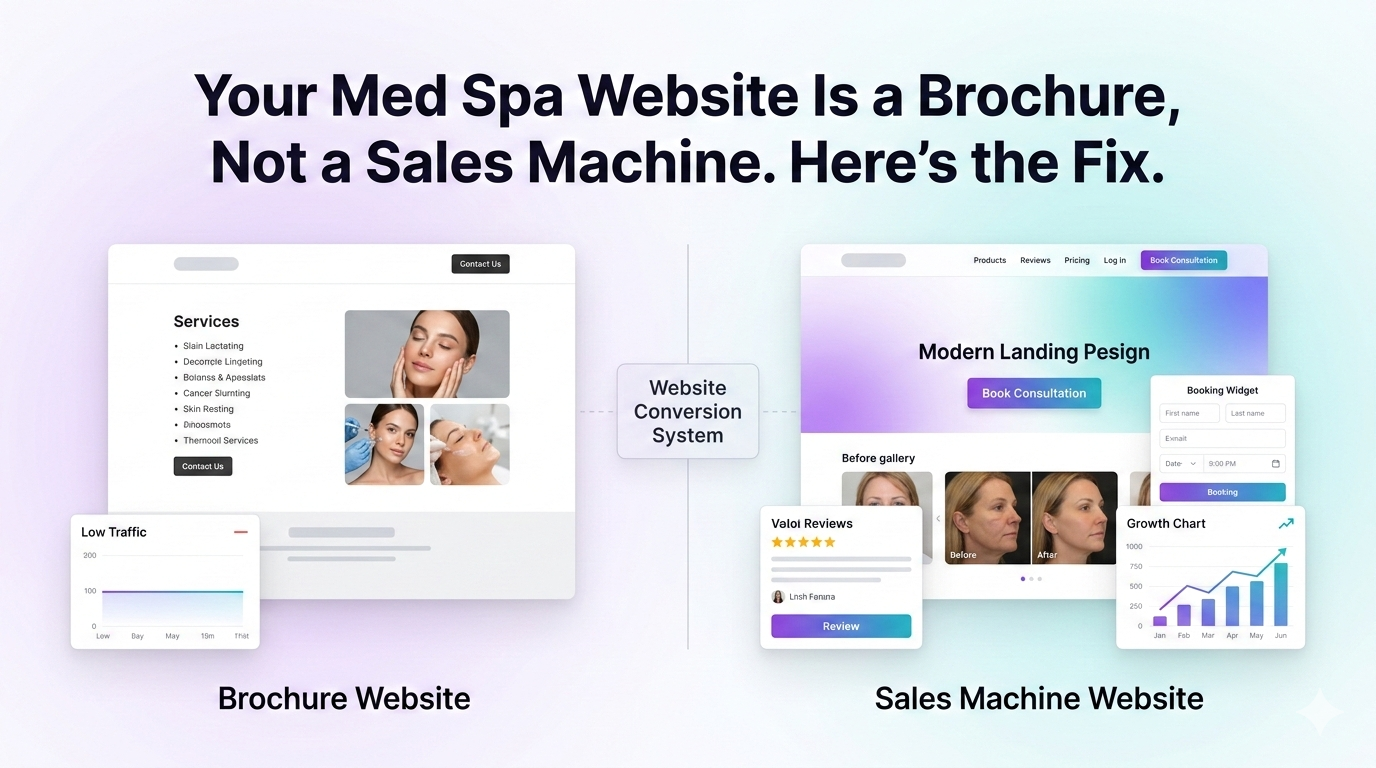
Your Med Spa Website Is a Brochure, Not a Sales Machine
The simple version: as we noted in our analysis of the infrastructure gaps costing med spas $47K annually, most med spa websites explain the practice well enough but still leave the booking work to the patient. They list services, show photos, and tell people to call. That is not enough.
A website should answer the next question, not just introduce the business. When it does not, you lose patients from Google, Instagram, ads, and every other channel you paid to bring in.
📑 Table of Contents
The Data: How Med Spa Websites Actually Perform
From our analysis of 1,836 med spa websites, here's what we found:
| Metric | Finding | Impact on Conversions |
|---|---|---|
| Title tags over 60 chars | 28.4% (522 sites) | Truncated in Google — message cut off |
| Title tags under 40 chars | 22.6% (416 sites) | Wasting valuable SEO keyword real estate |
| Optimal title tags (50–60 chars) | 25.9% (476 sites) | Only 1 in 4 get the basics right |
| No city in title tag | 54.7% (1,004 sites) | Invisible for "[service] + [city]" searches |
| Weak/missing meta description | 30.6% (562 sites) | No compelling reason to click in search |
| No crawlable SEO at all | 10.9% (201 sites) | Completely invisible to Google |
But here's the number that should worry you most:
Only 6.7% of the med spas in our dataset have CTA-heavy conversion-optimized copy. That means 93.3% — 1,713 med spa websites — are not optimized to convert visitors into booked patients. They're digital brochures.
💡 Critical Insight
Your website isn't just your online presence. It's the conversion layer for EVERY marketing channel you run.
- ✓ Google Ads send people to your website
- ✓ Instagram bio links send people to your website
- ✓ Organic search results send people to your website
- ✓ Google Business Profile links to your website
Every marketing dollar you spend ultimately ends up at your website. If your website doesn't convert, every dollar is worth 50–70% less than it should be.
Brochure Site vs Sales Machine: The 5 Critical Differences
1. Treatment-Specific Landing Pages vs. Generic Services List
Brochure site: One "Services" page listing every treatment with a one-line description. Maybe a stock photo.
Sales machine: Individual pages for Botox, fillers, CoolSculpting, laser hair removal, microneedling. Each includes 300+ words, pricing guidance, before-and-afters, FAQs, testimonials, and booking CTA above the fold.
Why this matters: When someone clicks a Google Ad for "Botox Austin TX," they should land on your Botox page—not hunt through a generic services list. Research shows every extra click or scroll loses 20–30% of visitors. A treatment-specific page matches their exact intent and shortens the conversion path.
For SEO, dedicated treatment pages let you rank for specific keywords. "Botox Austin TX" is a completely different ranking opportunity than "CoolSculpting Austin TX." A single services page cannot target both effectively. The med spas ranking at the top of local search in competitive cities like Austin and Boston all have dedicated treatment pages. This is table stakes.
2. Clear CTAs Above the Fold vs. Hidden Contact Info
Brochure site: Hero image with your logo and a tagline. Call-to-action buried at the bottom or hidden in the navigation under "Contact."
Sales machine: Clear, specific CTA visible without scrolling: "Book Your Free Botox Consultation." Phone number in the header. On mobile, a sticky "Book Now" bar follows users as they scroll.
The data: The average website visitor spends 54 seconds on a page. If your CTA isn't visible in the first 3–5 seconds, you've lost the majority of visitors who will never scroll down.
Above-the-fold CTAs increase conversion rates by 30–50% compared to CTAs requiring scrolling. This isn't a design preference. It's a measurable revenue difference.
3. Social Proof on Every Page vs. a Buried Testimonials Tab
Brochure site: "Testimonials" page buried in navigation with 3 text quotes from 2019 and no photos.
Sales machine: Google review rating in the header ("4.9 stars — 287 reviews"). Before-and-afters on every treatment page. Patient video testimonials embedded alongside service descriptions. Live review feed pulling recent Google/Yelp reviews.
Here's why: Med spa services are trust-intensive purchases. A patient is literally letting you inject substances or use a laser on their face. They need proof you're skilled, experienced, and safe before they hand over a credit card.
Social proof isn't a nice-to-have. It's the single biggest conversion lever on your entire website after a clear CTA. Every treatment page without before-and-afters and reviews is a treatment page that underperforms.
4. Embedded Booking Widget vs. "Call Us"
Brochure site: "Call us at (555) 123-4567 to schedule. Available Monday–Friday, 9–5."
Sales machine: Online booking widget embedded on every treatment page and homepage. Patients see available times, select their treatment, and book in under 2 minutes—at any time, day or night.
The reality: 67% of patients prefer online booking over phone calls. This isn't generational preference anymore—it's table stakes.
If the only way to book is by calling during business hours, you're losing every visitor who lands at 10 PM on Tuesday—which is one of the peak browsing windows for med spa services. An embedded booking widget converts 24/7, including nights, weekends, and holidays when your phone goes to voicemail. Pair it with an AI front desk for automated lead response and follow-up so no inquiry slips through.
5. Conversion Tracking vs. "We Got Some Calls This Month"
Brochure site: No analytics beyond "we seemed busier." No idea which channels drive which patients.
Sales machine: Google Analytics 4 tracking form submissions, booking completions, phone click-to-calls, and chat engagements. UTM parameters on every ad campaign, social media link, and email. Monthly reporting showing which channels drive which bookings at what cost.
The problem: Only 19.1% of med spas use UTM tracking on their Google Business Profile—their single most visible local listing. That means 80.9% can't tell you whether GBP drove 5 patients or 50.
Without tracking, you're making budget decisions based on gut feel instead of data. You're guessing which channels work, which campaigns to scale, and which to cut. And gut feel is wrong far more often than it's right.
The Conversion Multiplier Effect: Why This Matters for Every Marketing Dollar
Here's why your website is the most important variable in your entire marketing equation:
The Case Study: Same Traffic, 2.5× More Bookings
Case Study Insight
Two med spas. Same city, same services, same quality of care, same $3,000/month marketing spend.
- 🏪 Brochure website: 20 bookings/month = $8,000 revenue
- 🚀 Conversion-optimized website: 50 bookings/month = $20,000 revenue
Same traffic. Same budget. 2.5× more patients.
Let's break this down:
| Metric | Brochure Site | Sales Machine |
|---|---|---|
| Monthly website visitors | 1,000 | 1,000 |
| Website conversion rate | 2% | 5% |
| Monthly booked appointments | 20 | 50 |
| Average first-visit revenue | $400 | $400 |
| Monthly revenue from marketing | $8,000 | $20,000 |
| Cost per booked appointment | $150 | $60 |
| Monthly marketing ROI | 2.7x | 6.7x |
The Hidden Cost of a Brochure Website
Here's the uncomfortable truth: if your website converts at 2% instead of 5%, you need 2.5× more traffic to get the same bookings.
That means:
- 2.5× the Google Ads spend
- 2.5× the SEO investment
- 2.5× the Instagram effort
- All because your website is a brochure instead of a sales machine
Over a year, the revenue gap between these two med spas is $144,000 — on the same marketing budget.
⚠️ Critical Realization
This is the most expensive mistake in med spa marketing, and almost nobody talks about it because it's less exciting than running ads or posting Reels. But fixing your conversion rate is the highest-ROI activity you can do—period.
Growth Insight
Your website conversion rate is the multiplier for every dollar you spend on marketing.
A 1% increase in conversion rate is worth $36,000+ annually in additional revenue (on $3,000/month marketing spend).
Want to know your current conversion rate?
Book a Free Conversion Audit →The 30-Day Website Transformation Plan
The transformation from brochure to sales machine doesn't require a complete redesign or a $20,000 development project. It requires focused work in four weeks. Here's the exact roadmap:
📅 Week 1: Audit and Prioritize
- Page speed audit: Run your site through Google PageSpeed Insights. Fix anything scoring below 50 on mobile — slow sites kill SEO rankings and ad Quality Scores.
- Title tag audit: Rewrite any under 40 or over 60 characters. Add city + primary service to every page title.
- Meta descriptions: Rewrite all — 140–155 chars, include service + city, end with a CTA.
- Treatment ranking: Identify your top 5 revenue-generating treatments. These get dedicated pages first.
🏗️ Week 2: Build Treatment Pages
- Create dedicated pages for your top 5 treatments if they don't already exist.
- Each page must include:
- Treatment description (300+ words)
- Benefits list
- Before-and-after photos
- Pricing guidance
- Embedded booking widget
- CTA above the fold
- 5–10 FAQ questions
- Patient testimonials or reviews
- Internal linking: Link from homepage, navigation, and relevant blog content directly to these pages.
✨ Week 3: Add Conversion Elements
- Booking widget: Embed on every treatment page and homepage.
- Trust signals: Display Google review rating in header ("4.9 stars from 200+ patients").
- Visual social proof: Add before-and-after galleries on every relevant treatment page.
- Mobile optimization: Add sticky "Book Now" bar that follows users as they scroll on mobile.
- Click-to-call: Ensure phone number is visible on every mobile page without scrolling.
- Exit-intent offer: Deploy popup with special offer for first-time visitors: "First-time patient? Get a free skincare analysis with your first treatment."
📊 Week 4: Install Tracking and Go Live
- Google Analytics 4: Track form submissions, booking completions, phone clicks, and chat engagements.
- Meta Pixel: Install on every page for Instagram/Facebook retargeting.
- UTM parameters: Add to Google Business Profile link, all social media links, email signatures, and ad campaigns.
- Baseline measurement: Track conversion rate for 30 days, then optimize from there.
🎯 Pro Tip
You can't improve what you haven't measured. Spend Week 4 establishing your baseline. The data you collect now becomes your optimization roadmap for the next 90 days.
Internal Resource
This transformation aligns perfectly with our Med Spa Growth Stack framework—where your website is the conversion engine that makes SEO, Google Ads, and Instagram investments work 3× harder than they would in isolation.
The Bottom Line
Your website is the conversion layer for everything you do in marketing.
Every Google Ads click, every Instagram visitor, every organic search result, every GBP listing click — they all end up on your website. If that website is a brochure, you're paying full price for marketing and getting half the results.
Fixing that is a 30-day project that pays dividends for years.
The transformation from brochure to sales machine doesn't require a complete redesign or a $20,000 development project. It requires:
- ✓ Treatment-specific pages
- ✓ Clear CTAs above the fold
- ✓ Social proof on every page
- ✓ Embedded booking widget
- ✓ Proper conversion tracking
Four weeks of focused work. Measurable results within 60 days.
The 6.7% of med spas with conversion-optimized websites aren't better at marketing because they spend more. They're better because every dollar they spend works 2–3× harder than it does for the other 93.3%. That math advantage compounds every single month.
Ready to Transform Your Website Into a Sales Machine?
Want us to audit your med spa website and show you exactly where you're leaving money on the table?
Book Your Free Growth Audit →Related Articles
The Med Spa Growth Stack
How SEO, Google Ads, and Instagram Work Together to drive patient acquisition
Read more →
The 90-Day Med Spa Growth Sprint
A structured framework to accelerate your med spa growth and client acquisition
Read more →
Cost Per Booked Appointment in 2026
Industry benchmarks and the metrics you need to track for profitable med spa marketing
Read more →
Med Spa Marketing Math: Calculate Your Growth ROI
The formulas that show exactly how many patients you need and what they cost to acquire
Read more →